
Regional Capability Ecosystem
Employer Partners
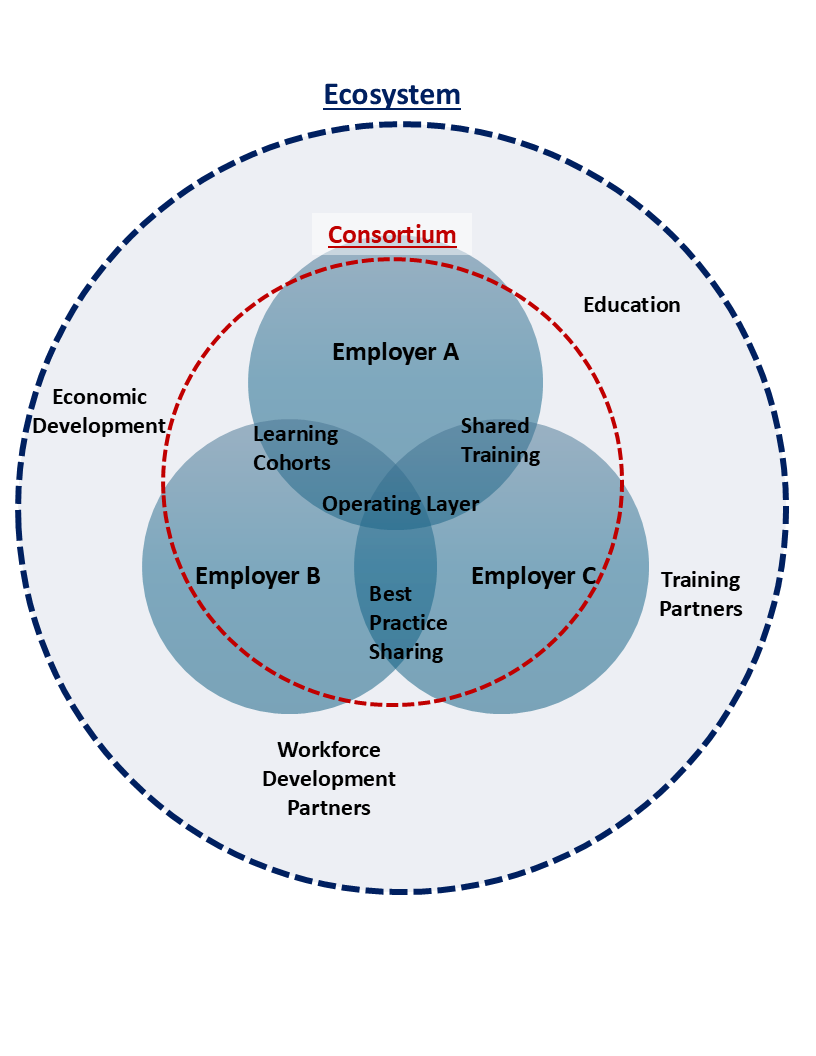
The Regional Capability Ecosystem connects employers, education systems, and workforce organizations into a coordinated system that strengthens both companies and the regional talent pipeline.
The ecosystem operates through an employer-led consortium that allows companies to collaborate on operational excellence, workforce development alignment, shared training initiatives, and help align how talent is prepared across the region.
The consortium’s operating layer manages much of the coordination and execution required to keep the ecosystem functioning, allowing employers to participate without significant administrative burden.
How Employers Benefit
Employers participate in the consortium to strengthen both their internal operations and the regional talent pipeline.
Participation provides:
• structured operational excellence training
• coaching and leadership development
• peer learning with other companies
• access to workforce training grants
• influence over student development pathways
Goals for Employers:
1. Strengthen Employer Capability
Help participating organizations develop stronger systems of operational excellence, leadership, and continuous improvement that increase productivity, resilience, and employee development.
2. Build a Strong Regional Talent Pipeline
Work collaboratively with education systems and workforce partners to help align student development with the competencies and skills employers need.
3. Improve Regional Competitiveness
Create a network of organizations committed to operational excellence and workforce capability that strengthens the region’s economy and supports long-term business growth.
How the Consortium Strengthens Employer Organizations
The Employer Consortium
The ecosystem is organized through an employer-led consortium that brings together organizations committed to strengthening their internal capability while helping shape the regional workforce environment.
A consortium is a collaborative structure in which multiple organizations work together to pursue shared goals that would be more difficult or costly to achieve independently. In this case, participating employers collaborate to strengthen operational excellence, support workforce development alignment, and build a more capable regional talent system.
Rather than each company trying to solve operational and workforce challenges on its own, the consortium allows employers to work together to:
• share knowledge and operational experience
• participate in structured operational excellence training and leadership development
• collaborate on workforce development challenges and solutions
• engage with schools and education partners in a coordinated way
• influence how regional workforce initiatives evolve
This collaborative structure allows participating companies to benefit from shared learning, shared resources, and coordinated action, while still maintaining full independence in how they operate their own organizations.
The consortium structure also aligns well with existing workforce development tools available in Kentucky, including programs supported by the Bluegrass State Skills Corporation (BSSC). BSSC encourages employer collaboration around workforce training and skill development and provides grants that can support training initiatives for participating organizations. By organizing through a consortium, employers can coordinate training efforts, pursue grant opportunities collectively, and expand access to resources that support workforce capability development.
This approach reduces duplication, spreads the cost of capability development, and creates a community of organizations committed to operational excellence and continuous improvement. It also strengthens the connection between employers, education systems, and workforce development organizations by providing a structured forum for collaboration.
Most importantly, the consortium ensures that the ecosystem remains employer-led, with participating organizations helping shape its direction, priorities, and future evolution.
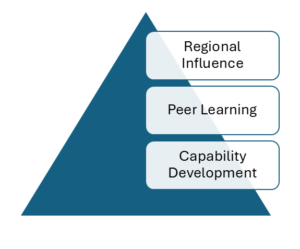
Capability Development
• Lean systems training and continuous improvement capability
• Leadership and supervisor development for operational excellence
• Coaching and guidance for solving operational challenges
• Organizational assessments and improvement roadmaps (Calibrate)
Peer Learning
• Cross-company learning cohorts and improvement forums
• Facility tours and best-practice sharing among members
• Collaborative problem-solving with other employers
• Small business roundtables and leadership discussions
Regional Influence
• Shape how regional talent is developed
• Influence workforce and education alignment
• Participate in internships, co-ops, and work-based learning initiatives
• Help strengthen regional economic competitiveness
Primary Benefits
Lean Systems Training
Employers gain access to structured training designed to build internal capability for continuous improvement and leadership development.
• Lean systems fundamentals
• Problem-solving and root cause analysis
• Standard work and process stability
• Continuous improvement leadership
• Frontline supervisor development
• Coaching and accountability systems
• Strategy deployment and goal alignment
Coaching and Organizational Development
Participating organizations receive guidance and coaching to help translate Lean principles into practical organizational improvements.
• leadership coaching for improvement culture
• guidance on operational system design
• support for leadership routines and accountability systems
• improvement project coaching
• development of internal improvement leaders
Shared Learning Cohorts
Employers participate in peer learning cohorts where companies work through improvement topics together and share practical experience.
• cross-company learning groups
• peer discussions on operational challenges
• shared learning around leadership systems
• collaborative capability development
• exposure to different operational approaches
Best Practice Exchange
The consortium creates opportunities for companies to learn from each other and accelerate improvement through shared experience.
• facility tours and learning visits
• sharing successful improvement practices
• presentations from member companies
• discussion of real-world operational challenges
• cross-industry knowledge sharing
Improvement Forums
Structured forums help companies address operational challenges and identify improvement opportunities.
• operational excellence discussion forums
• workforce capability development discussions
• regional industry improvement topics
• collaborative problem-solving sessions
• guest speakers and expert sessions
Kaizen and Continuous Improvement Events
The consortium may facilitate improvement events that help organizations accelerate operational learning.
• kaizen workshops
• focused process improvement events
• cross-company improvement initiatives
• improvement project demonstrations
• shared learning from improvement efforts
Student-Led Improvement Projects
Employers may engage with schools through structured improvement projects that benefit both companies and students.
• student problem-solving projects
• project-based learning partnerships
• student participation in improvement initiatives
• operational improvement case studies
• mentorship of student improvement teams
Strategic Alignment and Deployment
The consortium supports organizations in aligning improvement efforts with strategic objectives.
• strategy deployment workshops
• alignment of improvement priorities
• operational goal setting
• leadership planning sessions
• alignment between capability development and business strategy
Organizational Capability Assessments
Participating organizations gain access to assessment tools that help them understand their current state and identify opportunities for improvement.
• Calibrate operational excellence assessments
• leadership system assessments
• organizational capability benchmarking
• improvement maturity evaluations
• guided improvement roadmaps
Small Business Roundtables
Smaller organizations benefit from forums designed specifically for their operational challenges and development needs.
• small business leadership roundtables
• operational improvement discussions for smaller teams
• resource sharing between small organizations
• practical improvement approaches for smaller companies
• mentorship from more mature organizations
Talent Pipeline
Participating employers help shape and benefit from a stronger regional talent pipeline aligned with real workplace needs.
• Influence the development of student competencies and career pathways
• Engage with students through internships, co-ops, work study, and project-based learning
• Increase visibility of career opportunities within your organization and industry
• Access a more prepared and motivated workforce entering the regional talent marketplace
Through the consortium operating layer, much of the coordination with schools and workforce organizations is managed on behalf of participating employers, making it easier for companies to engage without significant additional burden.
Additional Benefits
Participating employers may also gain access to:
• coordinated grant opportunities (BSSC and others)
• workforce development collaboration with schools
• shared access to expertise and consulting resources
• regional economic development engagement
• participation in shaping the regional capability ecosystem
The Importance of Employer Excellence in the Ecosystem
Workforce development often focuses on preparing students for jobs.
But the success of those efforts depends heavily on the capability of the organizations that employ them.
Companies with mature systems of operational excellence and continuous improvement are able to:
• onboard and develop employees more effectively
• adapt to changing market conditions
• increase productivity and competitiveness
• provide clearer career pathways for employees
• continuously improve how work is performed
When employers build these capabilities, the entire workforce ecosystem becomes more effective.
Students enter organizations where their skills can grow.
Employees develop over time rather than stagnating.
Companies become stronger and more competitive.
For this reason, strengthening employer capability is a central element of the ecosystem.
Why Operational Excellence and Lean Systems Matter
Workforce development often focuses on preparing students for jobs, but the success of those efforts depends heavily on the capability of the organizations that employ them.
Many challenges described as “skills gaps” are actually symptoms of operational issues inside companies. When organizations lack stable processes, clear expectations, effective onboarding, and systems for developing people, even well-prepared workers struggle to perform, advance, or remain with the organization.
Companies with mature systems of operational excellence and continuous improvement are better able to absorb, develop, and retain talent. These systems create clearer standards, stronger problem-solving capability, and pathways for employees to grow their skills over time.
When employers operate with strong systems, the entire workforce ecosystem becomes more effective. Education partners gain clearer signals about workforce readiness, workforce programs align more closely with industry needs, and the region becomes more competitive.
For this reason, strengthening employer capability through operational excellence is a foundational element of the ecosystem.
The Operating Layer
The consortium operating layer manages most of the coordination and execution required to keep the ecosystem functioning, allowing employers to participate without significant additional administrative burden.
This operating layer helps:
- facilitate collaboration between employers and education partners
- translate employer capability needs into workforce competencies
- manage communication across ecosystem participants
- support consortium training and development activities
- identify and pursue grant opportunities
- coordinate regional initiatives
Many employers want to support workforce development and education partnerships but simply do not have the time or internal capacity to coordinate across schools, workforce organizations, and regional initiatives. Without a clear structure, even well-intentioned efforts can become fragmented and difficult for companies to sustain.
The consortium addresses this challenge through a dedicated operating layer that is managed and executed by our team under the direction of the employer-led consortium. This operating layer acts as the interface between employers, education systems, and workforce development infrastructure.
Our role is to handle the majority of the coordination, planning, and execution required to keep the ecosystem functioning effectively. We work directly with schools and workforce partners to translate employer capability needs into clear competencies, support the development of aligned career pathways, and coordinate opportunities such as internships, co-ops, project-based learning, and work-based experiences.
The operating layer also manages communication across participants, facilitates collaboration between organizations, identifies and pursues grant opportunities, supports consortium training initiatives, and helps solve problems that arise as the system evolves.
By managing these activities on behalf of the consortium, we significantly reduce the execution burden on participating employers. Companies are able to provide input, participate in key activities, and benefit from the system without needing to dedicate substantial internal resources to coordinating it.
In effect, the operating layer turns what would normally be a fragmented set of efforts into a coordinated system that continuously aligns employer capability, student development, and regional workforce priorities.
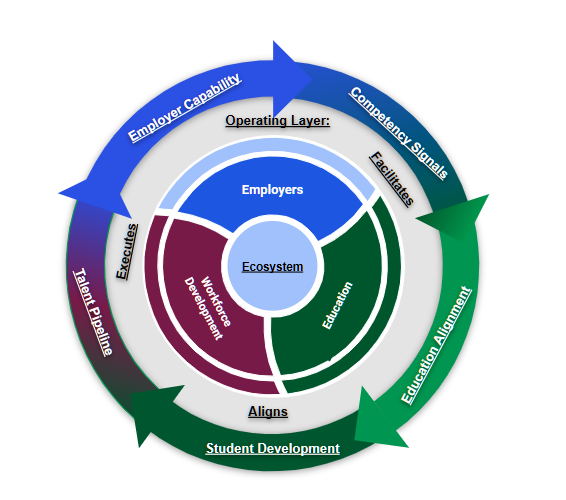
How the Operating Layer Connects Employers to the Education System
The ecosystem helps employers collaborate more effectively with local schools and education partners, while minimizing the time and coordination burden on participating companies.
The consortium’s operating layer facilitates much of the work required to translate employer needs into education alignment. Our team works directly with schools and education partners to assess current pathways, identify gaps, and support the development of future-state programs that better reflect the competencies and skills employers require.
Employers contribute primarily by providing periodic input and participating in select activities that help students better understand career opportunities and workplace expectations.
Employers may participate in activities such as:
• providing input on workforce competency needs
• supporting work-based learning opportunities
• hosting internships or co-op experiences
• offering plant visits or career exposure events
• participating in advisory groups for career pathways
Much of the coordination, planning, and ongoing communication between employers and schools is managed through the consortium operating layer, helping ensure alignment without requiring significant additional effort from participating organizations.
Importantly, schools maintain authority over curriculum and academic programs. The ecosystem simply helps strengthen communication and alignment between employers and education systems so both can work toward shared outcomes that benefit students, companies, and the region.
Funding the Consortium
Membership Contributions
The consortium is designed to make high-quality capability development accessible to a broad range of employers. The shared consortium model allows organizations to gain access to training, coaching, and ecosystem participation at a cost significantly lower than traditional consulting engagements.
Rather than establishing a fixed fee structure, membership contributions will ultimately be determined by the employer-led consortium itself. Participating companies will collectively decide how the model should be structured to best support their needs and priorities.
Our role is to provide guidance on expected costs and ensure that the structure remains sustainable while delivering meaningful value to participating organizations.
Shared Services Model
Because the consortium operates as a shared services model, companies are able to access expertise, training, and coordination at a fraction of the cost of traditional consulting.
As a general reference point, most organizations can expect participation to cost less than $5,000 per month, depending on their level of engagement and use of consortium resources.
This reduced cost is made possible by:
• shared consulting and training resources across multiple employers
• coordinated learning and improvement initiatives
• collaborative engagement with education and workforce partners
• our commitment to making participation accessible for a broad range of organizations
Tiered Participation
Membership contributions are intended to follow a tiered structure based on resource consumption and company needs.
Organizations that make greater use of consortium resources such as coaching, consulting, and training may contribute at higher levels, while companies with more limited needs can participate at lower tiers.
This approach allows the consortium to remain flexible and ensures that companies pay in proportion to the value they receive.
Small and mid-sized businesses are strongly encouraged to participate. The shared model can make access to operational excellence training and consulting far more economical for smaller organizations than pursuing these services independently.
Return on Investment
Our team is committed to ensuring that participating organizations receive greater value than the cost of membership.
We have a long track record of helping organizations achieve measurable improvements in productivity, operational performance, and leadership capability through Lean systems and continuous improvement.
The consortium model allows companies to capture these benefits while sharing the cost of expertise, coordination, and ecosystem development.
Leveraging Training Grants
The consortium will also actively pursue opportunities to leverage Bluegrass State Skills Corporation (BSSC) training grants.
These grants can support additional training initiatives beyond what membership contributions cover.
BSSC programs typically provide:
• up to $75,000 in annual training support
• requiring a 50% employer match
By coordinating grant applications at the consortium level, participating organizations can access additional resources that expand training opportunities and accelerate capability development.
Supporting Ecosystem Operations
A portion of membership contributions will support the day-to-day operations required to keep the ecosystem functioning effectively.
This includes activities such as:
• coordinating collaboration between employers, schools, and workforce partners
• managing training programs and development plans
• scheduling workshops, coaching, and consortium events
• facilitating communication and alignment across participants
• supporting continuous improvement of the ecosystem itself
These operational functions help reduce the coordination burden on participating organizations while ensuring the system remains effective and well organized.
Designed to Grow With the Consortium
Because the consortium is employer-led, the pricing structure can evolve over time as the system grows and the needs of participating organizations change.
The goal is to create a sustainable model that:
• supports meaningful capability development for employers
• strengthens the regional workforce ecosystem
• remains accessible for organizations of different sizes and industries
Building Stronger Companies and a Stronger Region
The Regional Capability Ecosystem is built on a simple idea:
Stronger companies create stronger communities.
By developing operational excellence inside organizations and aligning employers, schools, and workforce partners, the region can create a system that continuously develops talent and strengthens economic competitiveness.
Employers who participate in the consortium help lead this effort while gaining meaningful value for their own organizations.