
Regional Capability Ecosystem
Workforce & Economic Development Partners
Objectives
Workforce Development
1. Strengthen Alignment with Employer Needs
Improve visibility into the competencies and capabilities employers require so workforce programs can remain closely aligned with real industry demand.
2. Enhance Program Effectiveness
Support stronger coordination between workforce programs, education systems, and employers to improve training outcomes and workforce readiness.
3. Expand Employer Engagement
Create structured opportunities for workforce organizations to connect more consistently with employers through the consortium network.
Economic Development
1. Strengthen Regional Employer Capability
Support the development of stronger, more competitive employers through operational excellence and continuous improvement.
2. Improve Regional Talent Systems
Help align employers, education systems, and workforce programs to strengthen the region’s ability to develop and retain talent.
3. Increase Regional Competitiveness
Support economic growth by strengthening both employer capability and workforce readiness across the region.
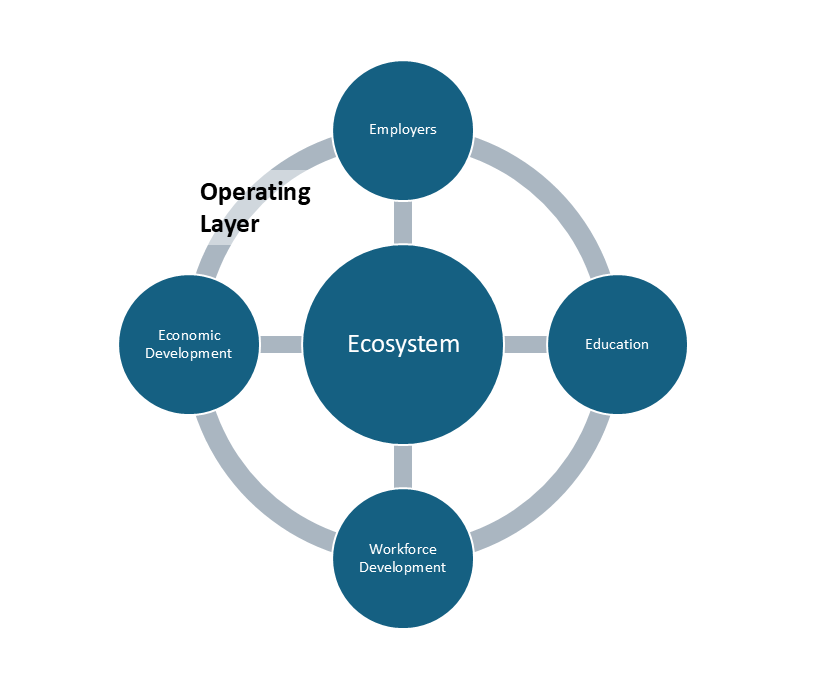
The Regional Capability Ecosystem strengthens the connection between employers, education systems, and workforce development organizations to support stronger talent pipelines and regional competitiveness.
Through an employer-led consortium and a dedicated operating layer, the ecosystem helps align employer capability needs with student development pathways and workforce programs. The goal is not to replace or compete with existing initiatives, but to support and amplify the important work already being done by workforce and economic development organizations.
By improving coordination, sharing signals across the system, and strengthening employer capability, the ecosystem helps workforce programs and economic development strategies deliver greater impact across the region.
Overview
Workforce development organizations and economic development agencies play an essential role in strengthening regional economies. These organizations provide critical services, including workforce programs, training initiatives, employer engagement, and economic growth strategies.
However, many regions face challenges because the systems that influence talent development often operate independently. Employers, schools, workforce organizations, and economic development agencies may all be working toward similar goals, but without a structured way to align efforts and share information consistently.
The Regional Capability Ecosystem provides a framework for stronger collaboration between these partners.
Through an employer-led consortium and a dedicated operating layer, the ecosystem helps coordinate communication between employers, education systems, and workforce organizations. This structured cooperation allows workforce and economic development partners to gain clearer signals from employers, better understand emerging capability needs, and align initiatives more effectively with regional economic priorities.
Rather than adding another program or layer of bureaucracy, the ecosystem acts as a coordination and alignment mechanism that helps existing efforts work together more effectively.
The Role of the Operating Layer
A key element of the ecosystem is the operating layer, managed and executed by our team under the direction of the employer-led consortium.
This operating layer helps coordinate activity across the ecosystem and serves as the interface between employers, education systems, workforce development organizations, and economic development partners.
The operating layer supports collaboration by helping to:
• translate employer capability needs into workforce and education signals
• facilitate communication between ecosystem participants
• coordinate training initiatives and development programs
• identify and pursue grant opportunities
• support strategic alignment between participating organizations
• monitor progress and share insights across the ecosystem
By handling much of the coordination and execution required to keep the ecosystem functioning, the operating layer allows workforce and economic development organizations to focus on their core missions while benefiting from stronger alignment with employers and education systems.
In this way, the operating layer acts as a multiplier, helping existing programs deliver greater impact through improved coordination and collaboration.
Benefits for Workforce Development Organizations
Workforce development organizations are central to the regional talent system. The ecosystem strengthens their work by helping connect workforce programs more directly to employer capability needs and education pathways.
Through the ecosystem, workforce organizations gain:
- clearer visibility into employer capability needs and evolving workforce demands
- stronger alignment between workforce programs and real industry requirements
- improved coordination with schools and education partners
- expanded employer engagement through the consortium network
- opportunities to connect workforce programs to operational excellence initiatives within companies
- stronger feedback loops that help refine workforce programs over time
These benefits help workforce organizations ensure that training programs, reskilling initiatives, and workforce services remain closely connected to the needs of the regional economy.
Benefits for Economic Development Organizations.
Economic development agencies work to strengthen the long-term competitiveness of their communities by attracting investment, supporting business growth, and building strong regional economies.
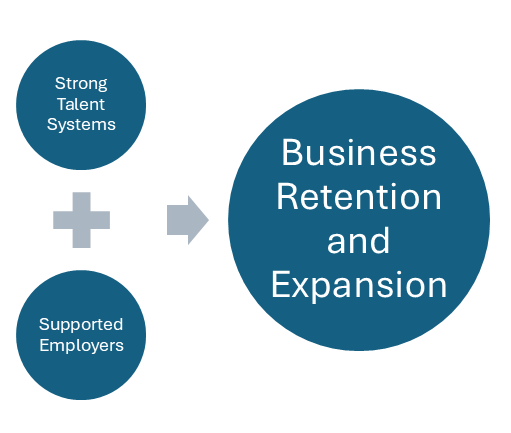
The Regional Capability Ecosystem supports these efforts by helping strengthen both employer capability and the regional talent pipeline.
Economic development partners benefit from:
- stronger local employers with more mature operational systems
- improved workforce readiness across the region
- stronger talent pipelines that support business expansion
- clearer signals about regional workforce capability
- stronger collaboration between employers, education, and workforce partners
- a regional narrative centered on operational excellence and workforce capability
By strengthening employer capability and improving workforce alignment, the ecosystem helps create the conditions that attract investment and support long-term economic growth.
Strengthening Regional Competitiveness
Regional competitiveness depends on more than simply attracting companies or creating training programs. It requires a system in which employers, schools, workforce organizations, and economic development partners work together to continuously develop talent and strengthen organizational capability.
The Regional Capability Ecosystem supports this goal by creating structured collaboration across these systems while preserving the independence and mission of each participating organization.
Over time, this approach helps create:
• stronger employers with greater operational capability
• better prepared workers entering the regional talent marketplace
• more effective workforce development programs
• greater economic resilience and competitiveness across the region
By aligning the systems that influence talent development and organizational capability, the ecosystem helps ensure that regional growth is both sustainable and broadly supported.
Pilot Program
This initiative is being launched as a pilot project designed to bring employers, education systems, workforce development organizations, and economic development partners together to test and refine a regional capability ecosystem. The goal is to learn collaboratively, drawing on the experience, expertise, and guidance of all stakeholders as the model develops. At the center of the pilot is an employer-led consortium, supported by a dedicated operating layer that coordinates activities across the ecosystem and helps reduce the administrative burden on participating organizations. As a learning system, the pilot will evolve through feedback and shared problem-solving, allowing the approach to be refined and scaled over time as it proves effective.